A park can be viewed as an infinite two-dimensional plane. There are $n$ street lamps in the park, labeled $1, 2, \dots, n$. Each street lamp can be viewed as a point in the two-dimensional plane.
Little A and his mother are visiting this park. His mother tells Little A not to run too far, so he can only play within a rectangular region with its bottom-left corner at $(0, 0)$ and its top-right corner at $(X, Y)$ (Little A can reach the boundary of the rectangle).
Little A is very interested in the $i$-th street lamp. He wants to find a location (let's call it point $P$) within the rectangle, and then let $d_k(P)$ be the distance from the $k$-th ($1 \le k \le n$) street lamp to $P$. After that, if $d_i(P)$ is the $j$-th smallest distance, meaning there are exactly $j-1$ distances strictly smaller than $d_i(P)$, then $P$ is called a "good point".
Little A wants to know: what is the total area formed by all good points $P$? If no good points exist, the area is 0. You need to find the corresponding answer for every pair $(i, j)$ ($1 \le i, j \le n$).
Input
Read the data from the file park.in.
The first line of the input contains three positive integers $n, X, Y$, representing the number of street lamps in the park and the coordinates of the top-right corner of the rectangular region where Little A can play.
The next $n$ lines each contain two integers $x_i, y_i$, representing the coordinates of the $i$-th street lamp. It is guaranteed that all street lamp coordinates are distinct.
The street lamps are not necessarily outside the rectangular region; they may be on the boundary or inside.
Output
Output to the file park.out.
Output an $n \times n$ matrix of real numbers (it is recommended to keep no more than 10 decimal places for each real number to prevent the output file from becoming too large), where the $i$-th row and $j$-th column represent the answer for the pair $(i, j)$. Separate two numbers in the same row with a space.
The contestant's output is considered correct if the relative or absolute error compared to the standard program's output does not exceed $10^{-6}$.
Examples
Input 1
1 3 1 1
2 -1 0
3 0 1
4 1 -1
Output 1
0.00000000 0.50000000 0.50000000
0.93750000 0.06250000 0.00000000
0.06250000 0.43750000 0.50000000
Note 1
Example 1 is shown in Figure 1. Region 1 is the trapezoid BGHD, Region 2 is the polygon GFJIH, and Region 3 is the triangle JEI, with areas $S_1 = \frac{1}{2}$, $S_2 = \frac{7}{16}$, and $S_3 = \frac{1}{16}$, respectively. These regions do not include their boundaries.
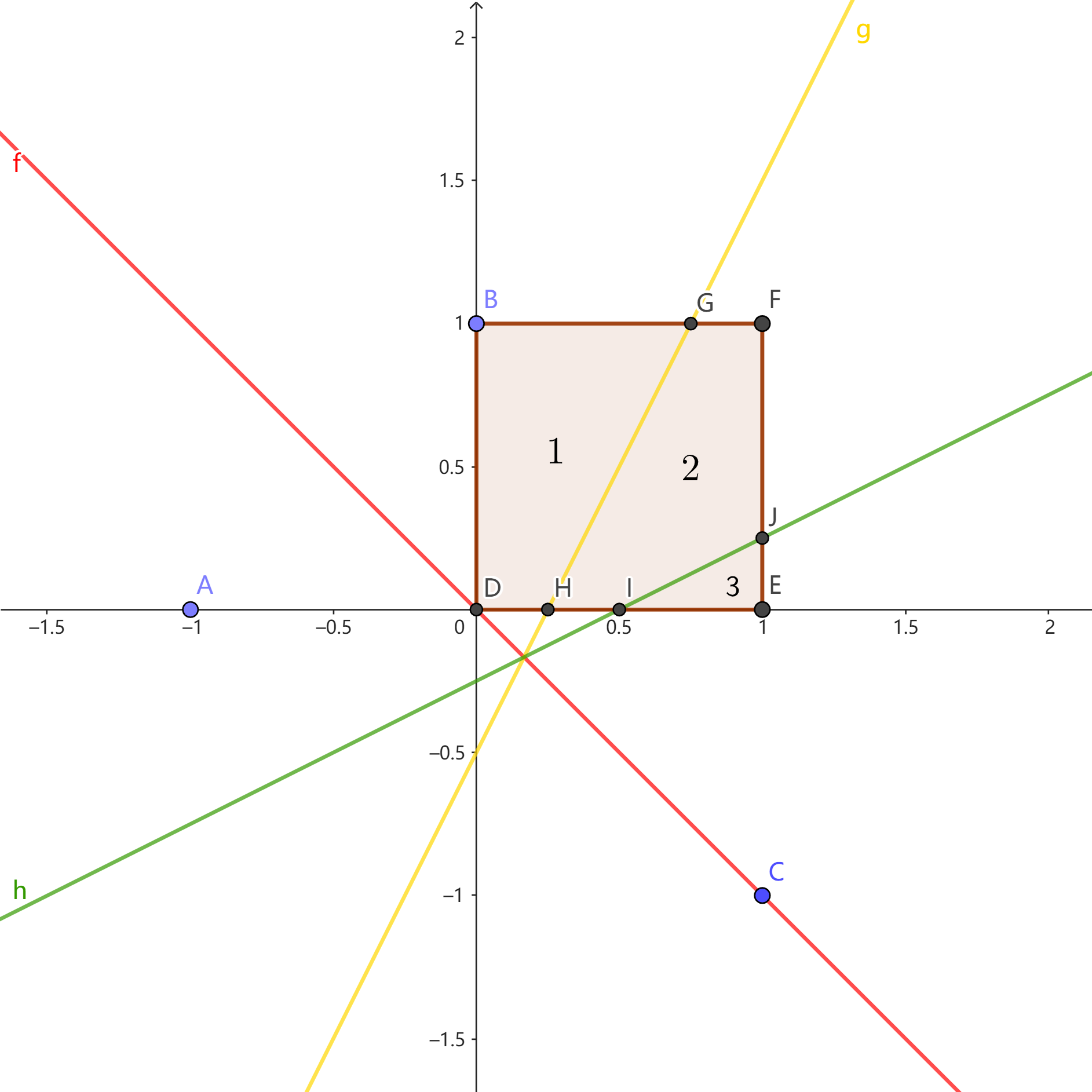
Figure 1: Illustration of Example 1
For points $P$ in Region 1, $d_1(P) > d_2(P)$, $d_1(P) > d_3(P)$, and $d_2(P) > d_3(P)$ are satisfied. For points $P$ in Region 2, $d_1(P) > d_2(P)$, $d_3(P) > d_1(P)$, and $d_2(P) > d_3(P)$ are satisfied. For points $P$ in Region 3, $d_1(P) > d_2(P)$, $d_3(P) > d_1(P)$, and $d_3(P) > d_2(P)$ are satisfied.
Therefore, for the first point: There is no region where $d_1(P)$ is the 1st smallest, so output 0. In Regions 2 and 3, $d_1(P)$ is the 2nd smallest, so output $\frac{7}{16} + \frac{1}{16} = \frac{1}{2}$. * In Region 1, $d_1(P)$ is the 3rd smallest, so output $\frac{1}{2}$.
Input 2
3 2 2
-2 1
2 4
4 1
Output 2
1.73958333 0.77083333 1.48958333
0.76041667 1.89583333 1.34375000
1.50000000 1.33333333 1.16666667
Input 3
3 3 3
3 5
-4 3
3 -5
Output 3
8.27678571 0.72321429 0.00000000
0.72321429 5.84598214 2.43080357
0.00000000 2.43080357 6.56919643
Examples 4
See park/park4.in and park/park4.ans in the contestant directory.
This example satisfies the constraints for test cases 1 ~ 4.
Examples 5
See park/park5.in and park/park5.ans in the contestant directory.
This example satisfies the constraints for test cases 5 ~ 7.
Examples 6
See park/park6.in and park/park6.ans in the contestant directory.
This example satisfies the constraints for test cases 8 ~ 10.
Examples 7
See park/park7.in and park/park7.ans in the contestant directory.
This example satisfies the constraints for test cases 11 ~ 12.
Examples 8
See park/park8.in and park/park8.ans in the contestant directory.
This example satisfies the constraints for test cases 13 ~ 14.
Examples 9
See park/park9.in and park/park9.ans in the contestant directory.
This example satisfies the constraints for test cases 15 ~ 20.
Constraints
For all test data, it is guaranteed that: $1 \le n \le 200$, $X, Y, |x_i|, |y_i| \le 10^6$.
| Test Case ID | $n$ | $X, Y, | x_i | , | y_i | \le$ | Special Property |
|---|---|---|---|---|---|---|---|
| 1 ~ 4 | 12 | $10^6$ | None | ||||
| 5 ~ 7 | 200 | $10^6$ | A | ||||
| 8 ~ 10 | 200 | $10^6$ | B | ||||
| 11 ~ 12 | 50 | $10^6$ | None | ||||
| 13 ~ 14 | 200 | 100 | None | ||||
| 15 ~ 20 | 200 | $10^6$ | None |
Special Property A: These $n$ points all lie on the same circle. Special Property B: These $n$ points all lie on the same straight line.