C-algae is the Byteotians' favourite dish of their national cuisine. C-algae have a very specific structure. An algae consisting of a single cell is a c-algae. Two c-algae $K_1$ and $K_2$, can be combined in either one of the following ways:
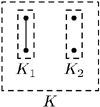
- by choosing all the cells from both $K_1$ and $K_2$, and all the connections from both $K_1$ and $K_2$,
- by choosing all the cells from both $K_1$ and $K_2$, all the connections from both $K_1$ and $K_2$, and setting further connections: each cell from $K_1$ is connected to every cell from $K_2$.
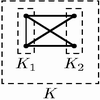
As a result we obtain a new c-algae $K$.
Unfortunately the hostile country of Bitotia has recently started selling algae imitating c-algae. These look so alike that it is hard to tell the difference between a false one and a genuine c-algae. This is the reason why the Byteotian government has asked you to write a programme that would allow verification if a given algae is a c-algae.
Task
Write a programme that:
- reads the descriptions of algae from the standard input,
- checks which of them are proper c-algae,
- writes the answer to the standard output.
Input
In the first line of the standard input a single integer $k$ is written, $1 \le k \le 10$, it denotes the number of algae to be examined. Descriptions of $k$ algae are written in the following lines. Each single description is of the following form: in the first line there are two integers written, separated by a single space, $n$ and $m$, $1 \le n \le 10\,000$, $0 \le m \le 100\,000$. They denote the number of cells and the number of connections respectively. The cells are numbered from $1$ to $n$. In the following $m$ lines the connections are described - each by two integers $a$, $b$, separated by a single space ($a\ne b$, $1 \le a,b \le n$), indicating that the cells $a$ and $b$ are connected. Each connection is specified once.
Output
$k$ lines should be written to the standard output. In the $i$’th line one word should be written:
TAK- (i.e. yes in Polish) - if the $i$’th algae is a proper c-algae,NIE- (i.e. no in Polish) - otherwise.
Example
Input
3
3 2
1 2
2 3
4 3
1 2
2 3
3 4
3 3
1 2
2 3
3 1
Output
TAK
NIE
TAK